Thursday, October 28, 2010

Go for Baroque


The itinerary for this very special day was St. Peter’s Basilica and the Vatican Museum.  We began with the basilica and the first thing that caught our eye when we entered was Michelangelo’s Pieta. And it is lovely.  It is hard to imagine he did this at the age of 23.


His dome is also quite spectacular.

The church is the ultimate in baroque and packed with popes who’ve been elevated to sainthood.


My church is bigger than yours
And for those who miss the artistic message glorifying the church and its saints, there are marks on the floor of the nave showing the length of other famous churches and demonstrating that St. Peter’s is indeed the largest by far.

But I found the crypt quite moving.  Here is the grave of St. Peter.  It is easy to accept this fact as true because Peter had many followers and was a well-known figure at the time of his crucifixion by Nero around year 60, and the early Christians would have venerated his grave from the beginning.  Not surprisingly, the grave became the keystone of the great church that we see today.  Also in the crypt are all of the popes who have not been sanctified.  It was very moving to see the grave of John Paul II.  It was the only monument with a guard, who was there to herd the many tearful mourners.  John Paul II is likely to be made a saint this year, and when he does, his remains will be moved upstairs to the basilica.

There are no paintings in St Peter's
They are very fine grained mosaics


A curiosity in the main church is the grave of Queen Christine.    She was the Swedish monarch who abdicated her throne and left her protestant faith to move to Rome and become a Catholic.  She is not a saint, however, and did not live the life of a saint.  My guidebook states that she was a woman of carnal appetites and chose the church to avoid marriage and the obligation to produce an heir.

The nuns at Fraterna Domus close the kitchen on Thursday, so we ate Pizza at a small Trattoria for lunch.  We were served and charged for a small appetizer that we did not order—a Roman practice that most tourists find irritating and we were no exception, even though we had been warned. 


As one would imagine, there are many souvenir vendors in the neighborhood of St. Peter’s.

Some of the souvenirs are in dubious taste.  

Père September?

The afternoon was spent at the Vatican museum, which is one of the great museums of the world.  It felt as vast as the Louvre.  The walk from the entrance to the Sistine Chapel, for example, is one third of a mile from the entrance.  We were thrilled to see the Laocoon—familiar to all of us from art history but we were unaware that it was in this museum.

Buns of stone


We had a similar reaction to Raphael’s enormous painting School of Athens.  It is probably Raphael’s greatest painting and it was extraordinary to see it in person.   Finally, we reached the Sistine Chapel and words cannot adequately describe it.  It is searingly beautiful.  We probably spent close to an hour looking up.  Binoculars are essential and Don had brought a pair.  Also essential is snagging one of the few seats.  The guards spend their time shushing people and chasing them off the steps and ensuring that the no pictures rule was enforced.
Leaving the Vatican Musuem

Museum time tends to be the most tiring and we were exhausted, so we separated from the tour for a little down time at the hotel before a very fine dinner at Angoletto, our Italian fine dining experience.  It was a huge hit—the pasta courses and the spinach were particularly wonderful.  A goal is to learn to make pasta in the Roman style.  

Wednesday, October 27, 2010

Il Pape !


We were up bright and early Wednesday to walk to St. Peter’s Square for our audience with the Pope.


Overnight parking is discouraged
   

We needed to be early for good seats because the tickets were for open seating and had been issued to 12,000 or so people.
People were there from all over the world.


We were behind a large group of Polish people with flags and red and white hats.  Fortunate to be very near the front, we had an excellent view of Pope Benedict when he encircled the crowd in his pope-mobile.
This event was somewhere between a rock concert and the Pasadena Rose Parade:  the crowd were cheering and shouting and the pope was smiling and waving like a beauty queen.


Nun standing on chair

But he is protected as a head of state—in addition to the wildly attired Swiss Guard, there was a phalanx of secret service men, and secret service posted through the crowds and on balcony.

The ceremony was in 5 or 6 languages and all of the locations of pilgrim groups were identified.  We were the pilgrims from Strasbourg, of course.  We cheered for France and the United States, however.  The homily or lesson was about St. Brigitte.   Her story of piety and celibacy in marriage and her founding of an order of nuns after her husband’s death didn’t really have a practical lesson.  But Père Regis had explained earlier that the talk was a catechism—that is, an opportunity to teach something about the church—and the Pope’s  theme recently had been the lives of the saints.  Members of the Brigittine order of nuns were in the audience and were recognized by the Pope.
The Pope does a blessing of religious articles and so we had brought crosses to be blessed.

We enjoyed this morning enormously.  It was fun to see the Pope and the faithful, and sitting all morning under the bright sun on a crisp autumn day was lovely.  It was also a nice break from the walking tours.  
Spot the American

Our afternoon church, appropriately, was another of the great basilicas of Rome—Ste. Marie Majeure.

This is the mother of the Mary churches—the first to be constructed that honored her.  Her important role in the Catholic Church is evident throughout—in the beautiful mosaic, for example, where Christ shares a single seat with her and places his hand on her crown. 


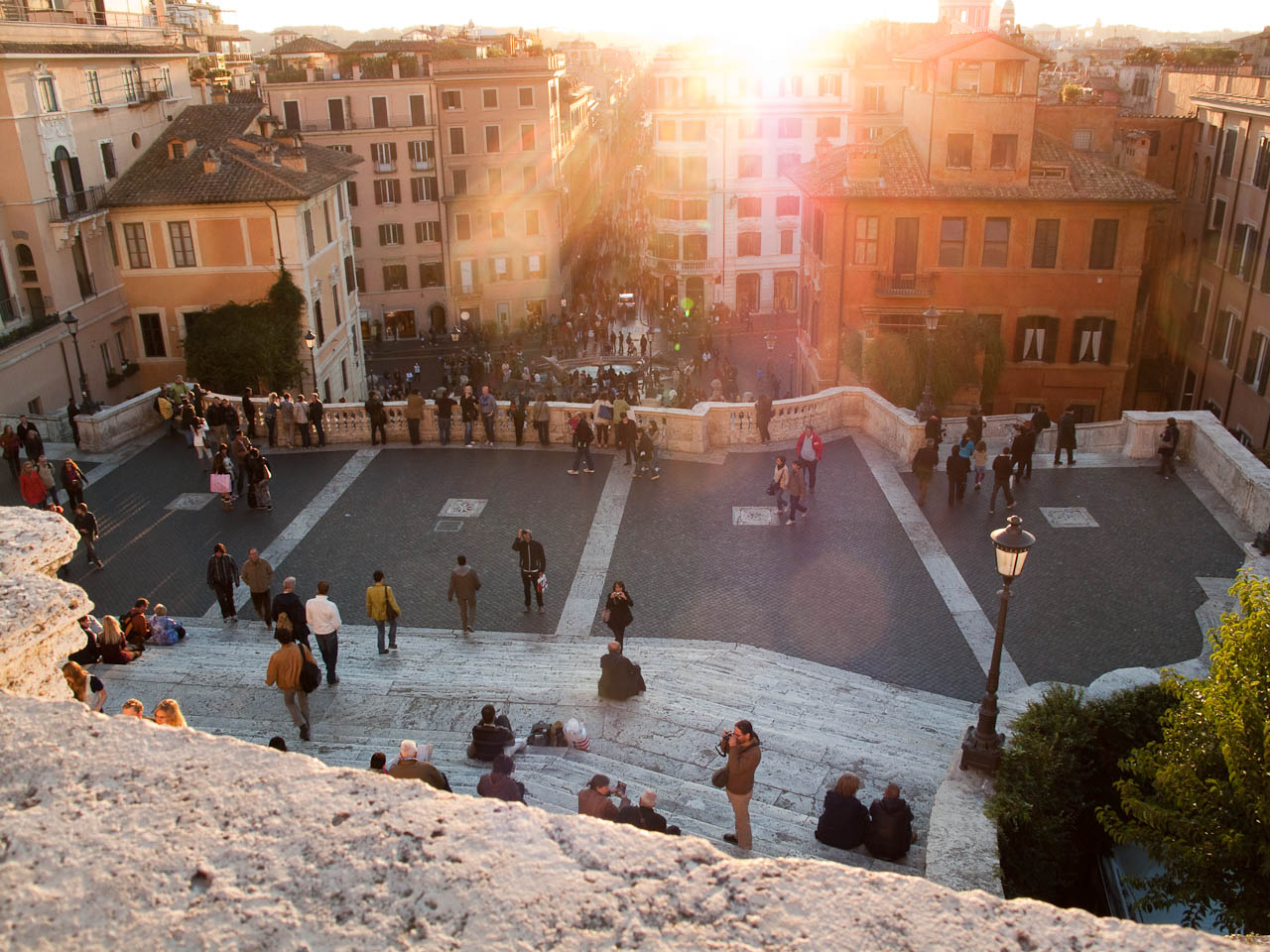
We proceeded to the Spanish Steps


and Via Condotti for window-shopping.  

In the evening after gelato, we walked over to the French Embassy.  It is in a stunningly beautiful building.  The building is not open to the public but the inside lights illuminated the interior art and architecture.  Unfortunately, Don opted out of this tour and there is no picture.

Tuesday, October 26, 2010

Three coins in the fountain


The morning was wet and ancient Rome was on the agenda.


We took a leisurely walk through the Forum, viewing the ruins of temples to Caesar, Jupiter, and vestal virgins, triumphal arches, and the public basilicas, which became the model for the great Christian churches. 


This triumphal arch was built after the defeat of the Jewish rebellion in Jerusalem—note the menorah from the great temple.  

Rome is a city of pigeons... and fountains of course.
We circled the coliseum.  This is another site that must be seen in person to be appreciated.  It is vast.  It is a ruin not because it fell down.  It was mined for centuries as building material for other Roman buildings.
The cross was added later to honor the Christian martyrs.  And, being sanctified protected it from further destruction.

The Romans were not charged to attend the games.  Because each of the arches at ground level is an exit (and an entrance), it could be vacated in 10 minutes. 

Modern Romans (some anyway) play dress-up as centurions, posing for pictures and then harassing tourists for tips.  

 The afternoon was the great baroque church St Jean de Latran.  This is the pope’s parish church.  It is gilded, golden, and full of statuary and mosaics, which really describes most of the churches that we saw.

The doors were from the ancient Roman Senate.
no tank tops either
Our favorite church, and certainly the favorite of our guide, was the Basilique St.-Clement.  This church is smaller than many that we visited but it is distinguished by its extraordinary history.  It has three levels.  The “modern” church was built in the 1200’s (the facade dates from the 1800’s) and includes a beautiful mosaic.  The older church was actually larger and dates from the fourth century.  It is built over a Mithrian temple, a pre-Christian sect that shared some significant beliefs with Christianity:  resurrection and a savior.  It is believed to be the site of early, secret, Christian worship and a place where apostles Peter and Paul actually spoke, spreading the gospel.  Unfortunately photos were not permitted inside this very special church.  

The evening walk was to the Trevi Fountain, a universal favorite.  The fountain is enormous and the roar from the water can be heard before the fountain can be seen.

Traditionally, one throws coins and makes a wish but the wish must be to return to Rome.  We were all very happy to make this wish!  

Monday, October 25, 2010

Roman holiday


We arrived in Rome shortly after 10 a.m.


at a small inn run by nuns, “Fraterna Domus.” 


 The hotel was perfect—simple but clean and comfortable.  We took almost all of our meals here.   Each lunch consisted of pasta, a meat and vegetable course, green salad, fresh fruit and a pitcher of wine.  Dinner was the same except that soup substituted for the pasta.  Again, it was simple but good.

Our tour began after lunch with a walk to Place Navone
with two great fountains:  the fountain of four rivers and the Neptune fountain.

Rome is a city of fountains

Père Regis provided radios and earphones and, throughout the tour, a nonstop explanation of the history, art and religious significance of what lay before us.

We also saw the Pantheon—it is really stunning and pictures do not do it justice.  The walls are 20 feet wide at the base to support the enormous dome.


It was raining lightly and the floor was wet under the oculus (opening).

Romans? enjoying a picnic at the Pantheon

Next we saw two churches, Il Gesu (an important Jesuit church) and Ste. Madeleine.
Cleaning Catherine


We took a fun detour from important monuments to check out the Pope’s tailor in an area featuring stores selling religious paraphernalia—everything from altarpieces to reliquaries.


Communion picnic?


Along the route was the Campo Marzio—ruins of the field where the Roman soldiers once trained and marched in triumph after a great victory. 

It is populated by a large number of cats. 
We visited San Luigi dei Francesi, the French national church, containing three gorgeous and dramatic Caravaggio paintings telling the story of St. Mathew. 


Pie' di Marmo
After the long afternoon of walking, we found this monument particularly apt

and paused for liquid refreshment

After dinner we visited Caffe Giolitti.  Giolitti is a wonderful gelato store near our hotel, which Père Regis introduced as the seventh great basilica of Rome. 
We made nightly pilgrimages,    hurrying back to the hotel to beat the hotel’s 11 pm curfew.